A Book Lovers Library
My name is Rebecca Graf. I am a book lover and a writer. I will read about any book you put in front of me. What do you get with me? Books of all kinds. You might find classics, romances, histories, how-to's, and anything else that might catch my fancy. Join me and share the joy of reading.
Welcome to my site. It is here I get to explore the world of reading and writing. Both are passions of mine. Each go hand in hand.

So, who am I?
 I am forty years old. I was born in Kentucky, but have lived in Alabama, Tennessee, Wisconsin, and currently in South Dakota. I graduated from college with a business degree and concentration in accounting. I worked my last year of college in a payroll department of a company. After graduation, I got an accounting job and worked for 19 more years in the field. With a bad economy and not liking my job, I found myself let go.
I quickly landed a job which I hated from day 1, but I seemed to be very good at, especially amazing given the pressure and competition. You see, I was responsible for the social media presence of a very large wholesale toilet tissue source. I tweeted and face booked the product for visibility and web traffic and sales boomed. Not because of me, mind you. You see, the toilet paper, along with appropriate dispensers were among the first products to be mass produced in China, so our tissues were significantly cheaper than our competitors. We shipped monthly increases in toilet paper sales amounting to 20% during peak periods. Then the market crashed as our suppliers made horrible decisions - basically they were losing money on every shipment and eventually went bust. Social media and toilet tissue just did not work out! With this disaster behind me, I decided with the encouragement of my husband to follow my dreams.
I went back to school to get my history degree with a minor in English. I'd love to teach and write. I also began writing online. I published a children's book, but did nothing outside of online writing for a couple of more years. It wasn't until the fall of 2011 with the encouragement of a friend of mine who writes and edits to put my dreams to paper. I began a couple of stories and the next thing I knew I was in the process of publishing a book.
What do I do now? I write. I have A Book Lover's Library where I post the majority of my reviews. I also write on a variety of topics on HubPages,healthy topics at Natural Family Today, health at Top TV Stuff, marriage at Blissfully Domestic, history at BellaOnline, history and ebook topics at Examiner, a variety of topics at The Beat 5 Boys Adventures, and I write novels.
My first book I wrote was A Gift for a Mouse. It is the story of a young mouse who witnesses the Last Supper and gives a new perspective on the event.
In July/August 2012, I will be releasing an adult novel (not that kind of adult) called Deep Connections. It is about a young woman who begins to fall for a friend when a stalker enters the picture and throws her life into chaos. Battling the emotions within of love, she finds herself hunted by something that's not human.
Later in 2012, I will also release a book called Trust Me. A woman is kidnapped only to be told it is for her own good. Nothing is easy as she begins to fall for her captor and has to decide if she can trust him with her life.
From there, I'll be releasing a few more books: The Nightingale in the Garden, The Men's Preservation Society, The Rooster's Crow, and Dark Connections.
The Nightingale in the Garden is the sequel to A Gift for a Mouse. In this book, a nightingale tells of what he witnessed in the Garden of Gethsemane one night that changed his life.
The Men's Preservation Society is a story set in the 1960s of a small town's group of women. They find their husband's being secretive about something. In multiple attempts to find out what they are doing, these women find themselves in some hilarious situations.
The Rooster's Crow (tentative title) is the next book in the mouse series. This tells the story of Jesus' trial and Peter's betrayal through the eyes of the most crucial character, the rooster that crowed.
Dark Connections is the sequel to Deep Connections. I really can't say more because I like to end things with cliffhangers and Deep Connections is no exception. You'll just have to wait until Deep Connections is out and then I'll tell you more.
In addition to all that, I have just partnered with three friends to start a publishing company called Silver Tongue Press. It's focus is to help new authors achieve their dreams though we'll take writing veterans, too.
+++
Book Reviews from 2012
Hot Coco
06/24/2012
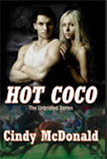
Never judge a book by its cover. This is especially true with Cindy McDonald's book Hot Coco. What you might think of as a hot, sexy romance turns out to be so much more.
A training facility for thoroughbreds. Families with different backgrounds. One hot bombshell. Horses smarter than the average equine. Mix all together and what do you get? A story of romance, comedy, and humble pie.
The story appeared slow moving at first. Once Hot Coco is introduced the story picks up and doesn't slow down. It moves from one character to another, as you see the scenarios through their eyes. One person perceives the scene in one light which causes them to act, leading to a whole new scene that doesn't quite make sense to the characters. The reader sees how the plot is laid out, while the characters find themselves in the dark. It turns out to be a comedy of errors that pushes people close to each other, and reveals the souls of people very deeply.
Ms. McDonald is very talented in drawing the reader in and giving them such a world to view. I couldn't put the book down as I moved from chapter to chapter, wanting to know what is going to happen next.
There are some references to intimate scenes through the thoughts and actions of the characters. There are no raw sex scenes. "F-bombs" are dropped periodically, as well as some lighter words. There are quite a few editing mistakes that may make you pause in your reading, but will in no way hurt the story.
The author does an exceptional job with various story lines pulled together that work like a well-oiled machine. The scenes are moved through quickly without hurting the overall story. The characters are enjoyable and easy to like or dislike depending on which one.
If you want romance with some laughs, you should read Hot Coco. It would make a great vacation or beach read.
*Disclosure of Material Connection: I am a member of The Virtual Book Tour Cafe' and a copy of this book was provided to me by the author. Although payment may have been received by The Virtual Book Tour Cafe', no payment was received by me in exchange for this review nor was there an obligation to write a positive one. All opinions expressed here are entirely of my own and may not necessarily agree with those of the author, the book's publisher and publicist or the readers of this review. This disclosure is in accordance with the Federal Trade Commission's 16 CFR, Part 255, Guides
++++
Return of the Viscount - A Book Review
06/23/12
For many, romances are perfect summer reads whether it is on the beach or on the porch. Historical romances can be extremely enjoyable. If those type of books interest you, you might want to check into Gayle Callen’s Return of the Viscount.
A young woman finds herself needing her inheritance but knows she’ll never get it. Her guardian controls it unless she gets married. The men courting her want to marry her for her fortune and to be the brother-in-law of an earl. She decides to marry a man who served under her deceased father’s command. What she doesn’t anticipate is her proxy married husband appearing on her doorstep or how gorgeous he turns out to be. Suddenly, accidents begin to happen to threaten her life. Can her new husband safe from harm as she battles the feelings she has for him?
This was a delightful story of romance, mystery, and secrets. The story moves along steadily between the various characters giving insight into both main characters’ thoughts and feelings. Nothing is as it appears with anyone which keeps the reader on her toes.
Ms. Callen writes in a manner that is entertaining and keeps the reader captivated. The characters are interesting and not one dimensional which makes you want to read to the very end. I loved how the story was not easily figured out though I did pinpoint the who half way through. The why slowly revealed itself as the author explained it all. Other than that I can’t say anything without spoiling it for you all.
There are several intimate scenes that are described in detail between the two main characters. There are no language issues.
The author does a great job putting the reader into a world of earls and countesses mixed with mystery and love. I couldn’t put it down and enjoyed it completely. Gayle Callen’s Return of the Viscount is a delightful read perfect for this summer’s reading bag.
Note: This book was provided by the publisher with no expectation of a positive review.
+++
Silver: Acheron
06/21/20120
I have never really been a fan of books or movies about a post-catastrophic world. I am finding material that is changing my mind. Silver: Acheron (A River of Pain) by Keira Michelle Telford is one of those convincing books.
The world is not as it is now. Most of it is gone. It is slowly being reclaimed by humans. The animals on the outside are hunted to make way for civilization. Yet civilization has its own dark side. Silver finds out when she is suddenly taken from the elite status of Hunter, to that of convict trying to survive with an unknown woman at her side and connections at the top of the police division. She finds her humanity threatened as she fights for her life and her sanity.
I really enjoyed the pace of this book that was fast most of the time, but not so fast that I could not follow. It kept me glued to the pages wanting to know what was going to happen next. The plot was very intricate, and the story line never flat lined.
Ms. Telford's writing is multi-dimensional, giving the reader a glimpse into a complicated and realistic apocalyptic world that I could easily see on the big screen. The characters had depth and the scenes created a world that had me mesmerized and slightly apprehensive.
There is language in this book, with several "f-bombs". There are suggestive scenes and words without going into too much detail of the depraved world Silver finds herself in. There were a rather large number of editing issues that did interfere with my reading, but did not detract from the story.
This is a story I am glad I had the chance to read. In fact, I am looking forward to reading the sequel. The author pulled one of my favorite things, leaving me hanging. As a reader I hate that, as a writer, I love that response. In that regard, I applaud Ms. Telford.
Give this book a chance. If the language, which is not excessive, doesn't turn you off, Ms. Telford will give you a pleasurable read, while leaving you wanting more.
*Disclosure of Material Connection: I am a member of The Virtual Book Tour Cafe' and a copy of this book was provided to me by the author. Although payment may have been received by The Virtual Book Tour Cafe', no payment was received by me in exchange for this review nor was there an obligation to write a positive one. All opinions expressed here are entirely of my own and may not necessarily agree with those of the author, the book's publisher and publicist or the readers of this review. This disclosure is in accordance with the Federal Trade Commission's 16 CFR, Part 255, Guides
+++
Dancing Naked in Dixie - A Book Review
06/16/2012
Wonderfully Delightful
Trying to classify Laura Clark’s Dancing Naked in Dixie has proved rather difficult. It is a romance while being a general fiction book with mystery and history all thrown in. I was drawn to this book because it was set in the South where I was born and raised. Ms. Clark did not disappoint me as she explored lower Alabama were I spent fifteen years of my life.
Julia Sullivan is a travel writer. She enjoys life and her job until she gets a new boss and a reprimand on the decline of quality of work she has been submitting. She has one chance and one chance only to save her job. She has to go to Eufaula, Alabama and write an article on a special event highlighting the town’s history. Getting there, she encounters many … unique characteristics of the South such as “darling” and “sugar” as well as fire ants, sweet tea, and ante-bellum homes. She discovers more than she bargained for as she gets sucked into a fight to save the town’s historical homes and learns more about herself than she thought possible.
The story moves along at just the right speed. It is not too fast or too slow. Ms. Clark does a fabulous job in creating a story that takes the reader from fast-paced New York City to the Deep South where things move at a slower pace. The storyline is believable while using scenes that one would not expect to find in real life but would enjoy doing so.
Ms. Clark’s writing style is casual and personal as she tells the story from Julia’s point of view and draws the reader into the feelings and thoughts of the woman. I found myself laughing at various scenes because I could see it happening and have with my own Northern in-laws. The introduction of Northerners to the South can be quite the experience. Julia’s first reaction to sweet tea does happen in real life. Seen it myself.
There are a few editing issues but nothing that would distract you from the story. I was disappointed that there was no mention of the statue dedicated to the boll weevil or about boiled peanuts both which confuse those from the North.
Ms. Clark writes in a very descriptive manner allowing the reader to see herself actually there and experiencing what Julia does. There is a lot of history about the Eufaula area described in the book making this more than just a story about a woman from New York. The book comes with a book club section with many questions to get the reader thinking about what they read as well as a recipe that I can’t wait to try.
Laura Clark is a former news anchor on television and has written another book on the Deep South called Stay Tuned. In February 2013, she will be releasing another novel titled, The Pie Lab.
I do recommend this book. It was a joy to read and brought back vivid memories of my youth. If you’re looking for a great summer read or a book to read while traveling, you have to check out Laura Clark’s Dancing Naked in Dixie.